Nature's Solace


Celebrating Nature in the Pacific Northwest
Northern Harrier - Circus cyaneus
If you've ever looked out over an open field and seen a hawk with a white rump patch flying low over the field hunting for its prey, you've seen the Northern Harrier. This characteristic behavior makes them one of the most easily recognizable of hawks.
On a clear morning in April in the open grasslands at the Dungeness National Wildlife Refuge, it was nest preparation time for the Norther Harriers. I watched as one Harrier dropped down into a concealed thicket of shrubs. She reappeared and dropped again into the open field, coming up with grasses and sticks, returning to the shrubs. We watched as this behavior was repeated several times. Of course I don't know the full story of what was happening, but it seemed clear that a nest was being prepared.
Males will sometimes start building a nest platform, but it's the female who finishes it. Later, they work together to bring in nesting material but the female takes charge of arranging them to form the nest which is completed in 1-2 weeks. The females incubates the 4-5 eggs and broods the chicks, while males provide most of the food for the females and nestlings.

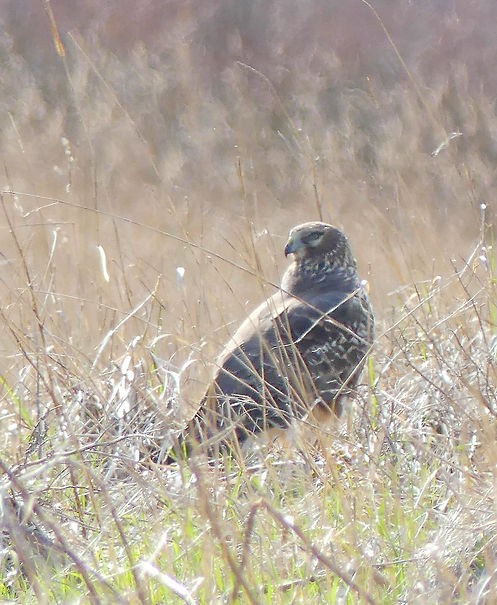
Female Northern Harrier - Males are distinctively different being gray above and white below with black wing tips. Both male and female have the characteristic
white rump patch.

Harriers have flat owl-like facial disks. Unlike most hawks who find their prey with their sharp hawk eyes, Northern harriers, like the owl, rely heavily on their sense of hearing to help it locate prey as they course low over the fields.
Resources:
While monogamy is common for the Northern Harrier, males may
also be polygamous, mating with two and even five females when food is abundant.
Courtship flights are quite acrobatic. The male advertises his territory. performing elaborate sky-dancing displays: undulating, rollercoaster-like flights up to 1,000 feet off the ground, sometimes covering more than half a mile. often performing 25 rises and falls. This also serves as a way to advertise his territory.
Being very adept in the air, they hunt almost exclusively on the wing for small mammals and birds. Their young get an early training. Once the young can fly, the parents feed them in mid-air, passing food to the first fledgling to reach them. Northern Harriers are long-distance migrants. They winter as far south as Panama, but are residents in other areas, including Washington.
During the winter, they may roost on the ground in groups. In the northern part of their range, their predominate prey is the vole.
There are 13 species of harriers worldwide. However, the Northern Harrier - formerly known as the marsh hawk, is the only harrier in North America.